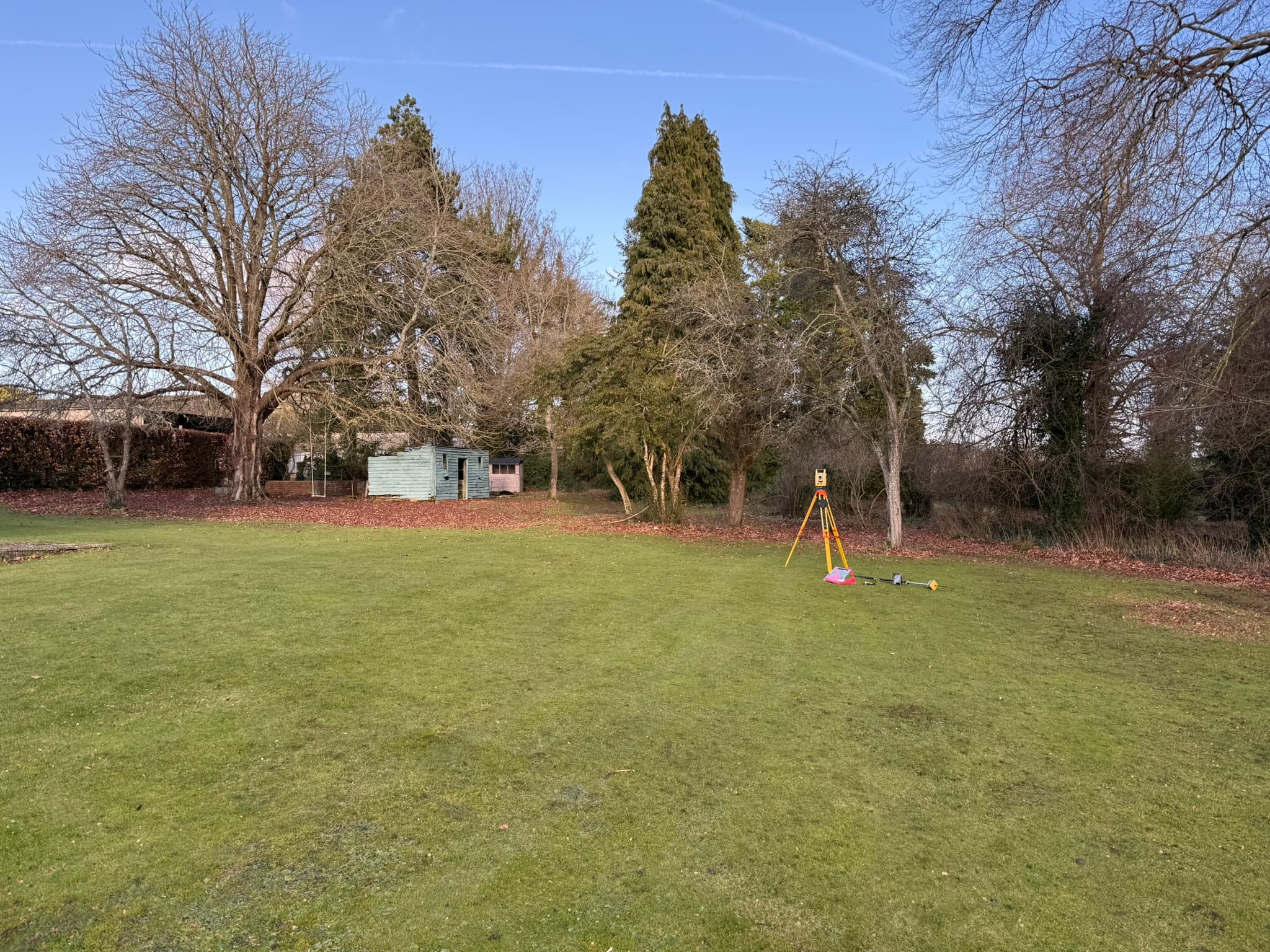

A topographical survey captures the physical features and levels of a site. It's the factual foundation for design work — architects, engineers, and planners need to know exactly what exists before they can propose what comes next.
This guide explains what topographical surveys measure, when you need one, and what to expect from the process and deliverables.
What Does a Topographical Survey Measure?
A comprehensive topographical survey records everything relevant to understanding a site. Exactly what's included depends on the site and the purpose, but typically:
Ground levels
The shape of the land — where it rises, falls, and how steeply. This is captured as:
- Spot heights — Individual level readings at specific points
- Contour lines — Lines connecting points of equal height, showing the landform
Levels are tied to Ordnance Datum (the national height reference), so they can be related to surrounding land, drainage systems, and flood risk data.
Buildings and structures
The position, footprint, and key heights of any buildings on or near the site:
- Outline positions
- Ridge and eaves heights
- Floor levels where accessible
- Significant features (entrances, steps, ramps)
Boundaries
Physical boundary features measured in position:
- Fences, walls, hedges
- Boundary markers
- Changes in surface treatment that indicate boundaries
Vegetation
Trees and significant planting:
- Position and canopy spread
- Species (where identifiable)
- Trunk diameter
- Estimated height
This matters for planning, arboricultural assessments, and design around existing trees.
Services and utilities
Visible evidence of services:
- Manholes and inspection chambers
- Utility cabinets and meters
- Overhead lines
- Surface drainage features
We record what's visible above ground. Below-ground services require separate investigation (GPR surveys or utility searches).
Watercourses and drainage
Any water features:
- Streams, ditches, ponds
- Surface drainage patterns
- Culverts and outfalls
- Invert levels where accessible
Other features
Anything else relevant to understanding the site:
- Road and footpath positions
- Kerbs and surface changes
- Street furniture
- Neighbouring features that might affect development
When Do You Need One?
Topographical surveys are typically required for:
Planning applications
Most planning applications for significant development need accurate site information. The local authority needs to assess the proposal against what actually exists — not what's shown on an out-of-date plan or rough sketch.
For householder applications (extensions, outbuildings), a topographical survey isn't always necessary. For larger developments, it almost always is.
Architectural design
Architects need accurate site information before they can design. You can't position a building sensibly without knowing the levels, or design drainage without understanding falls, or assess overlooking without knowing heights.
Starting design work without a proper survey leads to problems later — redesign, planning objections, or construction issues when reality doesn't match assumptions.
Engineering projects
Civil and structural engineers need accurate levels for:
- Foundation design
- Drainage design
- Cut and fill calculations
- Road and access design
- Retaining wall design
The more significant the engineering, the more important the accuracy.
Flood risk assessments
Understanding whether a site floods — and how development might affect flooding elsewhere — requires accurate level data. Flood risk assessments based on estimated levels aren't worth the paper they're written on.
Landscape design
Landscape architects need the same information as building architects — plus detailed vegetation data for designing around existing trees and planting.
Volume calculations
For earthworks, quarrying, or land remediation, topographical surveys provide the baseline for calculating volumes — how much material is there, or how much needs to be moved.
What About Existing Plans?
A common question: “Can't we just use the existing plans?”
Sometimes, yes. If you have a recent, accurate survey and nothing has changed, there's no need for a new one.
But often, existing plans are:
- Out of date — The site has changed since they were produced
- Not detailed enough — Produced for a different purpose
- Not accurate enough — Based on estimation rather than measurement
- Missing key information — Levels, trees, services not included
About OS Mapping
If you're not sure whether existing information is adequate, we can review it and advise.
Survey Accuracy
Modern surveys using GPS and total station equipment achieve high accuracy:
| Measurement | Typical Accuracy |
|---|---|
| Horizontal position | ±20mm relative |
| Vertical (height) | ±10mm relative |
| Absolute position | Can be tied to OS National Grid and Ordnance Datum |
“Relative accuracy” means the measurements are accurate in relation to each other. “Absolute accuracy” means they're accurate in relation to the national coordinate system.
For most design purposes, relative accuracy matters most — you need the survey to be internally consistent. For projects that must connect to existing infrastructure (roads, drainage), absolute accuracy becomes important.
We can achieve whatever level of accuracy your project requires.
The Survey Process
Brief and quotation
We need to understand:
- The site location and approximate extent
- The purpose of the survey (what decisions will it inform?)
- Any specific requirements (particular features, accuracy levels, output formats)
- Timescales
Based on this, we can quote and advise on the appropriate scope.
Site survey
The survey itself typically takes between a few hours and a few days, depending on site size and complexity. We use a combination of:
- GPS equipment — For establishing control points and surveying in open areas
- Total stations — For detailed measurement, particularly around buildings and in areas without GPS signal
- Laser scanning — For complex buildings or structures (where specified)
We'll need access to the site, obviously. For large sites, we may need to visit on multiple occasions.
Processing and drafting
Delivery
Finished surveys are delivered in your preferred format:
- DWG — For use in AutoCAD and most design software
- DXF — Universal CAD exchange format
- PDF — For viewing and printing
- Other formats — On request
Data can be provided as 2D plans, 3D models, or both. We can also provide data in specific formats required by particular software packages.
What's Not Included
A standard topographical survey covers visible above-ground features. It doesn't typically include:
- Underground services — Require GPR survey or utility searches
- Structural condition — Requires building survey by structural engineer
- Arboricultural assessment — We record tree positions and sizes; detailed health assessment requires an arboriculturist
- Ecological surveys — Separate specialist surveys
- Boundary determination — Topographical surveys record where features are, not where legal boundaries lie
If you need any of these additional services, we can advise on appropriate specialists or, in some cases, provide them ourselves.
Costs
Topographical survey costs depend on:
- Site size — Larger sites take longer
- Complexity — Dense features, significant vegetation, difficult terrain
- Level of detail — Standard site survey vs. highly detailed
- Access — Easy access vs. multiple visits required
- Deliverables — Standard plans vs. 3D models or specialist outputs
For a typical development site of an acre or two, expect costs in the range of £800–2,000 plus VAT. Smaller sites (garden plots, individual buildings) can be less. Larger or more complex sites will be more.
We're happy to provide a quotation based on your specific requirements.
Common Questions
How long does a survey take?
Site work: typically half a day to two days, depending on size. Processing: typically three to five working days after site completion. Urgent turnarounds can sometimes be accommodated.
Do I need to be there?
Not usually. We just need access to the site. If there are specific features you want to ensure are captured, it can help to meet on site at the start.
What if the weather is bad?
Modern survey equipment works in most conditions. Heavy rain or fog can slow things down, and we may need to postpone in extreme conditions, but normal British weather isn't a problem.
Can you survey a site I don't own?
We need permission to access land. If you're surveying a site you're considering purchasing, the vendor typically grants access for survey purposes. We can provide a letter explaining what's involved if that helps.
If you're planning development, construction, or significant landscape work, a topographical survey should be one of your first steps. It pays for itself many times over in avoided problems and better design.